
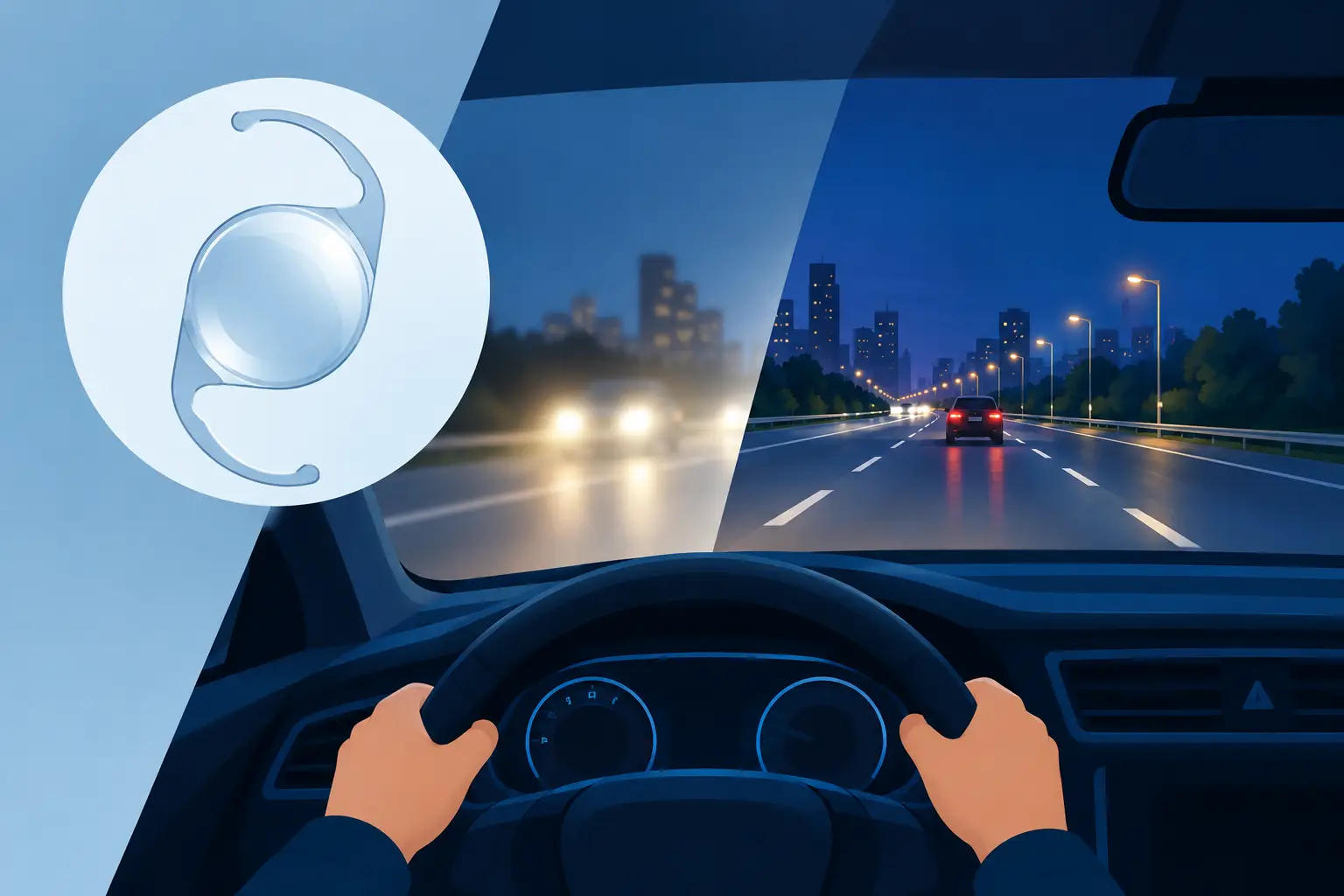
A wet road, oncoming headlights and small road signs can expose visual problems that barely register during the day. For people considering a Vivity lens for night driving, the key question is not simply whether they will see without glasses. It is whether the lens choice offers a sensible balance between a broad range of vision and comfortable vision in low light.
The AcrySof IQ Vivity is an extended depth of focus, or EDOF, intraocular lens. It is used in cataract surgery and refractive lens exchange to improve distance and intermediate vision, with some useful near vision for many patients. Its design is particularly relevant to people who want greater freedom from glasses but feel cautious about the halos and glare sometimes associated with multifocal lenses.
Why night driving needs a separate conversation
Driving after dark places greater demands on the eye than daytime driving. Pupils become larger, contrast is lower and bright lights are set against a dark background. Cataracts can make this worse by scattering light, creating starbursts, glare and a loss of definition around signs, kerbs and pedestrians.
Lens replacement can remove the cloudy natural lens in cataract surgery, or replace a clear but ageing lens during refractive lens exchange. However, no intraocular lens can recreate the young eye perfectly. Night vision after surgery depends on the lens selected, but also on the health of the cornea, retina and optic nerve, the accuracy of the prescription outcome and how the brain adapts to the new optical system.
This is why a patient who says, “I need to drive at night for work,” should receive a more detailed lens discussion than someone whose main aim is reading a menu without spectacles.
How Vivity works
Vivity is a non-diffractive EDOF lens. In plain English, it is designed to stretch the eye’s focus rather than splitting light into separate focal points, as a trifocal lens does. The intention is to provide clear distance vision and a useful intermediate range, such as a car dashboard, computer screen or supermarket shelf.
Its optical design may offer a more monofocal-like visual disturbance profile than diffractive multifocal lenses. This makes it an attractive option for patients who prioritise quality of distance vision and wish to limit the chance of noticeable halos. That does not mean halos, glare or starbursts are impossible. Every eye and visual system responds differently, particularly in the early weeks after surgery.
For close print, many Vivity patients still need reading glasses, especially in dim light or for small type. This trade-off matters. A trifocal lens can provide stronger near vision and greater spectacle independence, but it may be less suitable for someone whose regular night driving makes low-light optical symptoms a major concern.
Is Vivity good for night driving?
For a suitable patient, Vivity can be a very reasonable lens option when night-driving confidence is a priority. It aims to preserve good quality distance vision while giving more intermediate range than a standard monofocal lens. Many people value this combination because it supports activities such as driving, using satnav and seeing the dashboard without relying on distance spectacles.
Still, “good for night driving” is not the same as a guarantee of perfect night vision. The outcome depends on the condition that existed before surgery. If cataracts are causing glare, removal of the cloudy lens can make a meaningful difference. If the main issue is dry eye, irregular astigmatism, macular changes, glaucoma or a poorly controlled prescription, changing the lens alone may not solve it.
It also depends on your expectations. If avoiding reading glasses is your top priority, Vivity may feel like a compromise. If you are happy to use readers for detailed close work in exchange for potentially fewer optical compromises at night, it may be a more comfortable fit.
Vivity versus a monofocal lens
A monofocal lens is usually set for one main focal distance, most often distance. It remains a strong choice for people who want the simplest optical design and are content to wear glasses for reading and computer work. For night driving, a monofocal lens can offer excellent clarity when the eye is otherwise healthy.
Vivity adds an extended range beyond standard monofocal distance vision. That can reduce dependence on glasses for intermediate tasks without making near vision the central promise. The decision often comes down to how much you value dashboard and screen vision without glasses, alongside your tolerance for needing readers.
Vivity versus a trifocal lens
Trifocal lenses are designed to provide distance, intermediate and near vision, giving the greatest potential freedom from glasses. For the right patient, this can be life-changing. The trade-off is that diffractive multifocal optics can cause halos or glare around lights, particularly while the brain is adapting.
Some patients adapt well and are delighted with their range of vision. Others are more aware of night-time light effects. If you drive frequently on unlit country roads, work night shifts or simply find glare especially distracting, an EDOF option such as Vivity may deserve serious consideration. Your surgeon should discuss the relative benefits rather than steer every patient towards the same premium lens.
Who may be suitable for a Vivity lens?
A thorough assessment matters more than a quick online recommendation. Eye measurements help the surgeon plan lens power and identify factors that may influence visual quality. Corneal scans, retinal assessment, dry-eye evaluation and checks for astigmatism are all relevant.
Vivity may suit someone who wants strong distance vision, useful intermediate vision and less reliance on glasses, while placing high value on night-time visual comfort. It can also appeal to patients who are not keen on the potential visual phenomena associated with trifocal lenses.
It may be less suitable where there are significant retinal or corneal conditions, advanced glaucoma, untreated dry eye or expectations of reading very small print without glasses in all lighting. An astigmatism-correcting toric version may be considered where measurements show clinically meaningful astigmatism. Correcting this can be important for clear distance vision, including when driving.
What recovery can feel like
Vision often improves quickly after lens surgery, but the first few days are not the right time to judge your final night-driving result. Mild blur, fluctuating focus, light sensitivity and dry-eye symptoms can occur during early recovery. Prescription drops must be used exactly as advised, and the operated eye needs time to settle.
Neuro-adaptation is another part of the process. Your brain is learning to interpret the new lens optics, and this can take weeks or occasionally longer. During that period, lights may appear different and contrast may vary from one evening to the next.
Do not drive until your surgeon confirms that it is safe and you can meet the legal visual standard. More importantly, wait until you personally feel confident handling glare, judging distance and reading signs in the conditions you normally face. A short daytime drive is not the same as a rainy motorway journey after dark.
Questions worth asking at your consultation
A useful consultation should make the choice clearer, not more confusing. Ask how your cornea and retina look, whether you have astigmatism, and whether dry eye could be affecting your measurements or night-time symptoms. Explain how often you drive after dark and what situations concern you most.
It is also sensible to ask what level of reading-glasses dependence is realistic with Vivity, whether a monofocal or trifocal lens is a better fit for your priorities, and what support is available after you return home. For patients travelling from Ireland to Prague, organised pre-travel guidance and structured post-operative support can make a significant medical and practical decision feel far more manageable.
A lens is not “best” because it is the most advanced or because it promises the broadest range of vision. The right choice is the one that respects how you actually use your eyes. If clear, confident night driving matters deeply to you, make that the starting point of the conversation with your surgeon.