
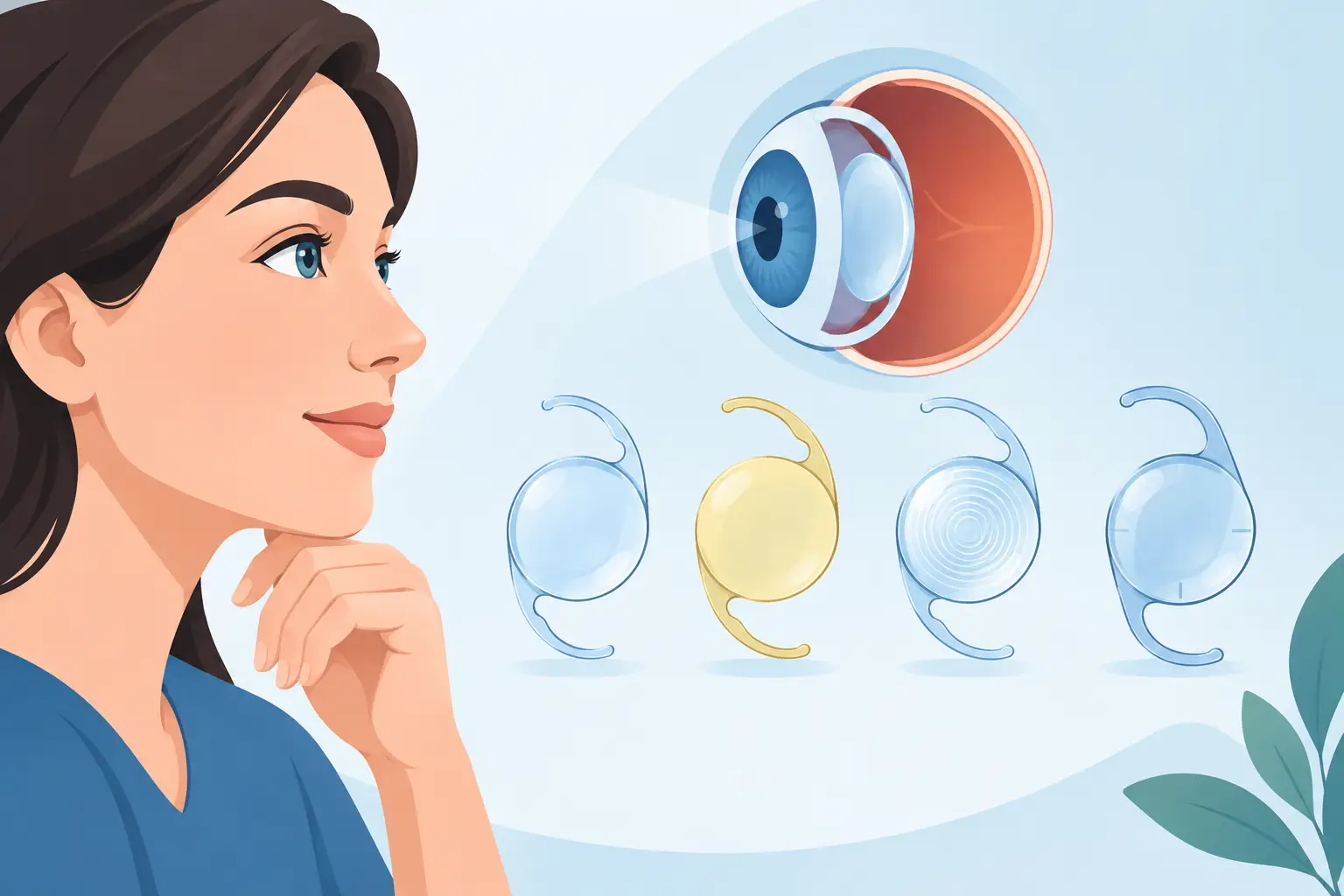
Your lens choice can determine whether you reach for reading glasses at breakfast, glasses for the dashboard, or neither for much of the day. Knowing how to choose intraocular lenses starts with a realistic question: which parts of your current visual routine would you most like to make easier, and what compromises would you be comfortable accepting?
An intraocular lens, or IOL, replaces the eye’s natural lens during cataract surgery or refractive lens exchange. It is a permanent decision, so the best lens is not automatically the most technologically advanced one. It is the one that suits your eyes, your lifestyle and your tolerance for visual side effects.
How to choose intraocular lenses around your daily life
Before comparing lens names, think through a normal day. Do you spend hours at a computer? Read books, labels or a mobile phone without wanting to find readers? Drive frequently after dark on Irish roads? Play golf, sew, work outdoors, or simply want clearer distance vision for travel?
These details matter more than a broad wish to be “glasses-free”. No lens can promise perfect vision in every light condition and at every distance. Your surgeon will use detailed measurements of your cornea, retina, pupil and natural prescription to establish what is clinically suitable. Your role is to explain what good vision means to you.
For example, a person whose priority is sharp distance vision and confident night driving may accept reading glasses. Someone who strongly dislikes readers and spends their day switching between a mobile phone, kitchen counter and television may place more value on near and intermediate range. Neither answer is better. It is about matching the optical design to your priorities.
Understand the main intraocular lens options
Monofocal lenses: clarity at one main distance
A monofocal IOL is designed to provide clear focus at one distance, most often distance. Many people enjoy crisp vision for walking, watching television and driving in daylight, while using glasses for reading and close work.
Monofocal lenses have a long clinical history and usually produce the least compromise in contrast and night-time visual quality. They can be an excellent choice for patients who drive after dark, have certain eye-health considerations, or prefer dependable distance vision over maximum freedom from glasses.
Some patients choose monovision, where one eye is set more for distance and the other slightly nearer. This can reduce the need for glasses for everyday tasks, but it is not suitable for everyone. A trial with contact lenses may help show whether your brain is comfortable with the difference between the eyes.
EDOF lenses: a broader everyday range
EDOF means extended depth of focus. These lenses aim to extend clear vision beyond a single focal point, usually giving good distance and useful intermediate vision for activities such as using a laptop, seeing a supermarket shelf or viewing a car dashboard.
Vivity is a well-known EDOF lens option. It is often considered by people who want greater freedom from glasses than a standard monofocal lens can offer, but who are concerned about the halos and glare sometimes associated with trifocal designs. Reading very small print may still require glasses, particularly in dim light.
The trade-off is straightforward: EDOF lenses can make daily life more convenient across distance and intermediate ranges, yet they do not usually deliver the same near focus as a trifocal lens. They are often a balanced choice for patients who want to prioritise driving and active day-to-day vision while reducing, rather than eliminating, dependence on readers.
Trifocal lenses: the greatest potential freedom from glasses
Trifocal IOLs are designed to provide distance, intermediate and near vision. For suitable patients, this can mean less reliance on glasses for tasks from watching television and using a computer to reading menus and checking a mobile phone.
That wider range involves a more noticeable adjustment period for some people. Halos around lights, glare and starbursts can occur, particularly at night. These effects often become less intrusive as the brain adapts, a process called neuro-adaptation, but they should never be dismissed as irrelevant. If you regularly drive at night for work or feel highly sensitive to visual disturbance, discuss this candidly with your surgeon.
Trifocals can be a very rewarding option for people who place a high value on near vision and are willing to accept that night-time vision may feel different, especially in the first weeks or months after surgery.
Do not overlook astigmatism and eye health
Astigmatism is caused by an irregular corneal shape and can blur vision at all distances. If it is significant, a toric version of a monofocal, EDOF or trifocal lens may be recommended. Correcting astigmatism at the same time can make a meaningful difference to the final result, so ask whether it has been measured and whether a toric lens is appropriate.
Not every premium lens suits every eye. Dry-eye disease can affect pre-operative measurements and should be treated before final lens calculations are made. Conditions affecting the cornea, optic nerve or retina, including macular changes, may also alter the safest recommendation. In some situations, a monofocal lens is the sensible choice because it preserves contrast quality and keeps expectations realistic.
This is not a failure to qualify for a premium option. It is good clinical judgement. The right recommendation should be based on what gives your eyes the best chance of useful, comfortable vision over the long term, not on selecting the most expensive package.
Ask questions that reveal the real trade-offs
A good consultation should leave you clear about more than the lens brand. Ask what level of spectacle independence is realistic for your prescription and eye health. Ask which distance the proposed lens prioritises, whether astigmatism correction is included, and what you may notice when driving at night.
It is also reasonable to ask about the surgeon’s experience with the recommended lens type, the diagnostic testing used to calculate your implant power, and the plan if your vision needs further assessment after surgery. A surgeon cannot guarantee that you will never need glasses again, but they should explain the likely outcome in plain English.
If you are travelling abroad for treatment, clarity around the practical pathway matters too. Confirm what the quoted price includes, such as the lens implant, local anaesthetic, medication and final post-operative examination. Understand when you need to arrive, how long you should remain in Prague, and how your recovery will be supported once you are back in Ireland.
At SANDONIA, lens replacement treatment in Prague starts from €843 per eye, with monofocal, EDOF/Vivity and trifocal options discussed according to individual suitability. A lower treatment cost should not mean a rushed decision. It should mean you can access a clearly explained plan, experienced clinical care and organised support without paying inflated private prices at home.
Give your eyes time to adapt
Vision after lens replacement is not always identical from the first morning. It is common for sight to sharpen over days and weeks as the eye heals. Dryness, fluctuations in clarity and sensitivity to light can occur early on. With multifocal or trifocal lenses, neuro-adaptation may continue for longer while the brain learns to use the new pattern of vision.
Follow your post-operative drops schedule carefully and attend the recommended checks. Contact the clinic promptly if you experience increasing pain, a sudden reduction in vision, marked redness, flashing lights or a curtain-like shadow. These symptoms need timely assessment rather than waiting for them to settle.
Choose the lens you will value on an ordinary Tuesday
The most satisfying lens choice is rarely based on a brochure claim. Picture an ordinary Tuesday: making tea, answering messages, working, shopping, driving home at dusk and reading before bed. Tell your surgeon which of those moments you want to make simpler, and be equally honest about what you do not want to compromise.
A well-chosen IOL can reduce the daily friction of glasses and contacts for many years. Give the decision the same care you would give to the surgery itself, ask direct questions, and choose a plan that feels clinically sound as well as financially sensible.