
A new pair of reading glasses on the kitchen table, contact lenses that feel less comfortable than they once did, or distance vision that is no longer as sharp when driving at night – these are often the moments that prompt people to compare laser surgery versus lens exchange. Both treatments can reduce reliance on glasses, but they work in very different ways. The right choice depends less on which procedure sounds more advanced and more on your age, prescription, eye health and the kind of vision you want for everyday life.
For many patients travelling from Ireland, the decision also includes value. Private treatment should be clear about what is included, what recovery involves and whether the procedure is likely to meet realistic expectations. A proper assessment is the starting point, not a sales pitch.
Laser surgery versus lens exchange: the essential difference
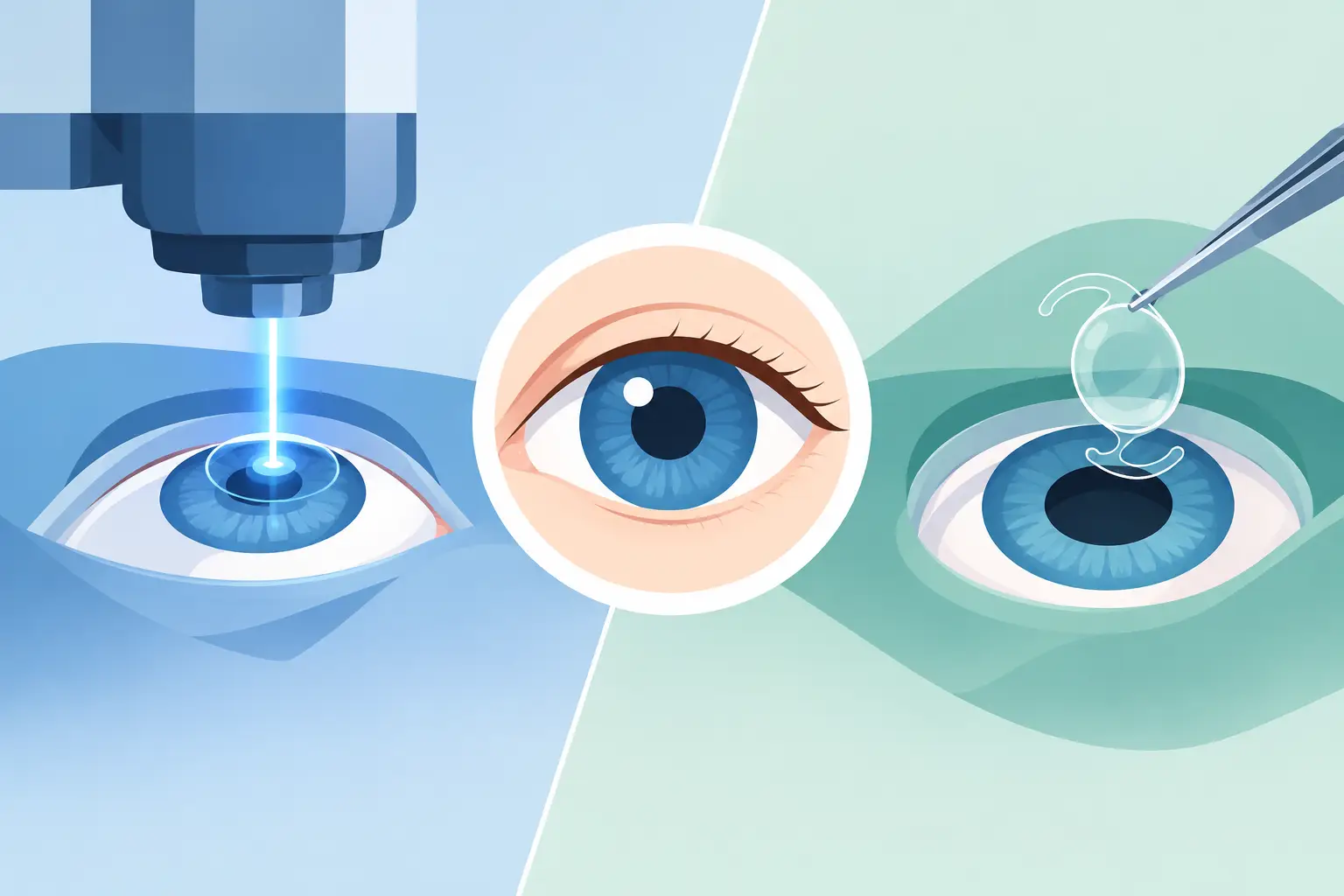
Laser eye surgery reshapes the cornea, the clear front surface of the eye. By changing how light enters the eye, it can correct short-sightedness, long-sightedness and astigmatism. Procedures such as FemtoLASIK and iDESIGN iLASIK are designed for suitable patients who want less dependence on glasses or contact lenses without changing the eye’s natural lens.
Lens exchange, also called refractive lens exchange or RLE, works inside the eye. The natural lens is removed and replaced with an artificial intraocular lens. This is the same core technique used in modern cataract surgery, although refractive lens exchange is usually chosen before a cataract has become significant.
That difference matters because laser surgery corrects the eye’s focusing system at the cornea, while lens exchange addresses the ageing natural lens itself. As we get older, that lens becomes less flexible. This is why reading small print, menus and mobile phone screens becomes harder, usually from the mid-forties onwards. It is called presbyopia, and it cannot be permanently reversed by standard laser correction alone.
When laser eye surgery may be the better fit
Laser eye surgery is often considered by adults whose prescription has been stable and who have healthy corneas of adequate thickness. It can be an excellent option for people with short-sightedness, long-sightedness or astigmatism who are generally younger and do not yet have a strong need for reading glasses.
The attraction is understandable. Treatment is quick, there is no lens implanted inside the eye, and many suitable patients return to normal routines relatively soon after surgery. For someone in their thirties or early forties who mainly wants freedom from contact lenses for driving, sport or work, laser surgery may be the more conservative way to improve distance vision.
However, laser surgery does not stop the natural lens from ageing. A patient who has laser treatment in their forties may still need reading glasses later, and they can still develop cataracts in the future. This does not make laser surgery a poor choice. It simply means the procedure should fit your current eye health and long-term visual priorities.
Corneal shape, thickness, dry-eye symptoms, prescription stability and retinal health all need careful review. Severe dry eye, certain corneal conditions or an unsuitable prescription may mean laser treatment is not advised. A responsible clinic should be comfortable saying so.
When lens exchange may offer more lasting freedom from glasses
Lens exchange is commonly considered by people over about 45 to 50, particularly those already reaching for reading glasses or finding that varifocals no longer suit their lifestyle. It can also be appropriate for patients with stronger long-sighted prescriptions, high short-sightedness, or prescriptions outside the comfortable range for laser treatment.
Once the natural lens is replaced, it cannot later form a cataract. That is a practical long-term advantage for patients who are already experiencing age-related lens changes. It also gives more scope to tailor vision through the choice of intraocular lens.
A monofocal lens is usually selected for clear distance vision, with reading glasses still needed for close work. An EDOF lens, including Vivity-style options, aims to provide a broader range with good distance and intermediate vision, often reducing the need for glasses for tasks such as computer use, cooking and shopping. Trifocal lenses are designed to provide the greatest range across distance, intermediate and near vision, offering the best prospect of day-to-day spectacle independence for suitable patients.
No premium lens is a guarantee that glasses will never be needed. Fine print, dim lighting and detailed close work can still require help. Premium lenses can also produce halos or glare around lights, especially in the early recovery period. The brain normally adapts over time, a process called neuro-adaptation, but patients who drive frequently at night should discuss this openly during their consultation.
The trade-offs worth discussing before you decide
Neither option is automatically better. A 38-year-old with a stable short-sighted prescription and healthy corneas may be well suited to laser treatment. A 58-year-old who needs reading glasses, has early lens changes and wants to reduce dependence on varifocals may find lens exchange the more logical long-term choice.
Lens exchange is an intraocular procedure, so it involves entering the eye and carries the risks associated with eye surgery, including infection, inflammation, retinal complications and the possibility of needing further treatment. These complications are uncommon, but they deserve a clear explanation. Patients with very high short-sightedness, previous eye surgery, retinal concerns or glaucoma need especially careful assessment.
Laser surgery also has recognised risks. Temporary dry eye, fluctuating vision, glare, halos and under- or over-correction can occur. Some patients may need an enhancement, while others may not be suitable for one. The goal is not to choose the procedure with no risk – there is no such procedure – but to choose one where the expected benefit is worthwhile for your individual eyes.
Cost should be considered in the same practical way. Lens exchange is usually more expensive than laser surgery because it includes a replacement lens and intraocular surgery, yet it may offer greater value for an older patient who would otherwise need future cataract surgery. At SANDONIA, lens replacement surgery in Prague starts from €843 per eye, with the final price depending on the lens selected and treatment plan. It is sensible to compare like for like, including diagnostics, surgeon care, medication and follow-up rather than focusing on a headline price alone.
Why detailed diagnostics matter more than a quick answer
A good recommendation comes from measurements, not age alone. Your assessment should consider your current prescription, corneal mapping, eye pressure, tear film, lens clarity, pupil size and retinal health. Your surgeon will also need to understand how you use your eyes: whether you drive at night, spend long hours on screens, play golf, sew, read extensively or work with detailed close vision.
This conversation helps determine whether monovision is worth considering with laser surgery, whether an EDOF lens offers the right balance, or whether a trifocal lens is realistic for your priorities. It also identifies situations where the safest decision is to wait, treat dry eye first, choose a different lens or continue with glasses.
For patients travelling to Prague, planning should include more than the procedure itself. You need clear pre-travel instructions, local support, the appropriate post-operative examination and a defined plan for recovery once you return to Ireland. Vision can be blurred initially after lens exchange, and eyes may feel dry or gritty after either treatment. Prescribed drops, avoiding eye rubbing and attending follow-up checks all support safe healing.
Choosing the treatment that suits your next decade
The most useful question is not, “Which procedure is best?” It is, “Which procedure is best for my eyes and the way I want to live?” Laser surgery can be an excellent corneal treatment for the right patient. Lens exchange can be a powerful option for people whose natural lenses are already limiting both near and distance vision.
Take your time with the decision, ask about the compromises as well as the benefits, and choose a clinical team that explains both plainly. Clearer vision is valuable, but confidence comes from knowing why the treatment recommended for you is the right one.